
How to Make Corporate Events Memorable: The Psychology Behind Gifts Guests Never Forget
Every event planner has had the same sinking feeling: months of work, a significant budget, a perfectly executed agenda — and two weeks later, nobody remembers it. Attendees merge it with every other corporate event they've sat through. The venue was nice. The food was fine. The keynote was... something about leadership.
The uncomfortable truth is that most corporate events are forgettable not because they're badly planned, but because they're designed around logistics instead of psychology. The science of memory formation tells us exactly what makes experiences stick — and it has almost nothing to do with production value.
If you want to learn how to make corporate events memorable, the answer lives in behavioral psychology, not in a bigger AV budget. Here's what the research actually says, and how the smartest event planners are applying it.
The Peak-End Rule: Why Your Guests Only Remember Two Moments
Nobel laureate Daniel Kahneman's peak-end rule is perhaps the most important concept in event design that most planners have never heard of. The theory is simple: people don't judge an experience by its average quality. They judge it almost entirely by two moments — the emotional peak (the most intense point) and the ending.
This means your $50,000 venue rental, your carefully curated menu, and your branded welcome packets are essentially invisible in long-term memory. What guests remember is the single most emotionally charged moment and whatever happened last.
The implications for event planners are profound. Instead of spreading your budget evenly across every touchpoint, concentrate resources on creating one genuinely extraordinary moment and a strong closing experience. Everything else can be competent — it's the peak that does the heavy lifting.
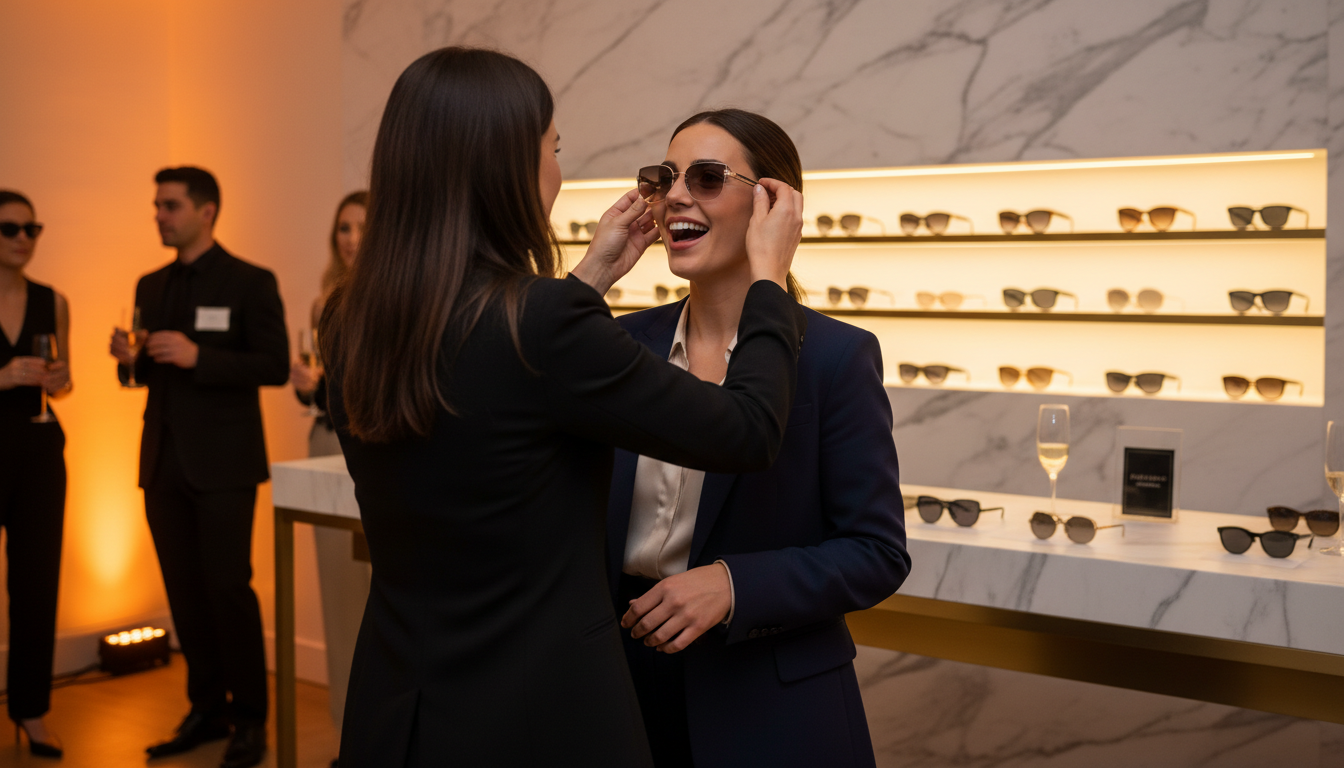
This is precisely why on-site gifting activations are becoming the centerpiece of high-performing corporate events. When a guest steps up to a curated display of 1,000+ designer sunglasses, works one-on-one with a professional stylist, and walks away wearing a pair of Ray-Bans or Maui Jims they chose themselves — that's the peak. It's personal, it's exciting, and it's the moment they'll tell their colleagues about on Monday morning.
The Endowment Effect: Why Choosing Makes Corporate Events Memorable
Behavioral economists have documented the endowment effect extensively: people assign significantly more value to things they feel ownership over. In controlled studies, subjects who were given a coffee mug and then asked to sell it demanded roughly twice what buyers were willing to pay. The mug didn't change — the sense of ownership did.
Now apply this to corporate gifting. A gift card sitting on a hotel pillow? The recipient feels no ownership until they eventually use it (and many never do — gift card breakage rates hover around 6-10%, with many more going months before redemption). A branded tote bag they didn't ask for? Zero endowment effect.
Contrast that with an experience where guests browse a curated collection, try on multiple styles, get expert advice on face shape and lens color, and personally select the pair that feels right. Every step deepens the sense of ownership. By the time they walk away, those sunglasses aren't a corporate gift — they're their sunglasses. The psychological difference is enormous, and it's why guests who go through a fitting activation consistently rate the experience as the highlight of the event.
Social Proof and the Compound Energy Effect at Large Events
There's a reason concert crowds feel more electric than listening to the same music alone. Social psychologists call it social facilitation — our emotional responses amplify in the presence of others experiencing the same thing. For events with 100-500+ guests, this creates a powerful compounding effect that solo gifting experiences simply can't replicate.
Picture the dynamics at a sunglass activation for 200+ guests. The first 20 people try it and walk away wearing designer frames. Their colleagues notice. Conversations start: "Where did you get those?" "Have you been to the sunglass bar yet?" By mid-event, there's a buzz — a visible, social energy centered around the activation. People who weren't initially interested find themselves drawn in by curiosity and social proof.
This compound energy effect is one of the reasons on-site gifting activations scale so well for large events. The more guests who participate, the more social proof builds, and the more the activation becomes the event's defining moment. For planners managing throughput at scale, multi-station setups with professional fitting specialists can process 40-60+ guests per hour without sacrificing the one-on-one experience that makes each interaction feel personal.
The Reminiscence Bump: Turning a Gift Into a Daily Memory Trigger
Cognitive psychologists have identified what they call the reminiscence bump — the tendency for certain objects and experiences to become memory anchors that trigger vivid recall every time we encounter them. This is why a song from a pivotal life moment can instantly transport you back to that exact feeling, even decades later.
Most corporate gifts fail the reminiscence test completely. A branded pen goes into a drawer. A gift bag gets sorted through once and discarded. Even high-quality gifts like electronics become generic once the novelty fades — they don't carry the emotional signature of the event.
Designer sunglasses occupy a unique psychological space. They're worn regularly (especially during travel, outdoor events, and leisure — all positive emotional contexts). Every time a guest puts on the pair they selected at your event, the reminiscence bump fires. They don't just remember receiving a gift — they remember the experience of choosing it, the person who helped them find the perfect fit, and the event where it all happened.
This is why smart companies invest in gifts that integrate into daily life. The cost-per-impression math becomes extraordinary when a single gift generates hundreds of positive brand associations over its lifetime. A $150 pair of sunglasses worn 200 days over two years delivers a cost-per-impression under $0.75 — with each impression carrying genuine positive emotion rather than the indifference of a logo on a water bottle.
The Paradox of Choice: Why Curation Matters More Than Variety
Barry Schwartz's paradox of choice research showed that too many options can paralyze decision-making and decrease satisfaction. But the inverse is equally problematic — too few options feel restrictive and impersonal. The sweet spot for gifting activations is a curated selection that feels abundant without being overwhelming.
This is where the design of an on-site sunglass bar becomes critical. A well-designed activation presents 15-30 styles in a way that feels like walking into a luxury boutique, not scrolling through an infinite catalog. Professional fitting specialists serve as guides, narrowing the field based on face shape, style preferences, and intended use. The guest feels like they had meaningful choice without the anxiety of unlimited options.
For VIP gift box programs, tiered selections (like the VIP Red, Gold, and Black tiers) accomplish something similar remotely. Each tier offers enough variety to feel personalized while maintaining the premium, curated feel that prevents decision fatigue. The Black tier, with access to 1,000+ styles including Gucci, Prada, and Oliver Peoples, works because the online experience includes filtering tools and styling guidance — replicating the curation effect digitally.
How to Make Corporate Events Memorable at Every Scale
The psychological principles above aren't abstract theory — they translate directly into planning decisions. Here's how they apply at different event scales:
Intimate events (10-50 guests): The peak-end rule is your entire strategy. Create one extraordinary gifting moment — a private sunglass fitting with champagne, perhaps — and close the event on that high note. With smaller groups, every guest gets extended one-on-one time with a fitting specialist, deepening the endowment effect.
Mid-size events (50-200 guests): Social proof becomes your amplifier. Position the gifting activation in a high-traffic area where early participants become walking advertisements. Corporate retreats and offsites at this scale benefit from placing the activation during a social period — cocktail hour or the final evening — when energy and conversation are already flowing.
Large-scale events (200-500+ guests): Throughput planning determines whether the compound energy effect works for you or against you. Multi-station setups with 3-4 fitting specialists can handle the volume while maintaining the personal touch. President's Club events and incentive trips at this scale often run the activation across multiple sessions rather than a single time block, ensuring every guest gets the full experience without long waits. The key is that even at 500 guests, each person's individual moment of choosing their pair feels intimate and personal — that's the psychological magic of a well-run activation.
What Forgettable Events Have in Common (and How to Break the Pattern)
After analyzing hundreds of corporate events, a clear pattern emerges among the forgettable ones. They share three psychological failures:
First, they distribute value evenly instead of creating peaks. The budget goes toward making everything "nice" rather than making one thing extraordinary. The appetizers are good. The centerpieces are lovely. The gift bag has six branded items. Nothing is remarkable enough to become a memory anchor.
Second, they treat guests as passive recipients rather than active participants. Attendees sit. They listen. They receive. There's no moment where they make a meaningful choice, engage their senses, or experience something that requires their active involvement. The difference between room drops and on-site activations captures this perfectly — one is a gift left on a pillow, the other is an experience a guest walks through.
Third, they produce nothing that triggers daily recall. The event ends, and there's no artifact from the experience that naturally integrates into the guest's life. The branded notebook goes in a stack. The USB drive is obsolete. The common corporate gifting mistakes almost always trace back to choosing items that don't survive the trip home, let alone become part of someone's daily routine.
Breaking this pattern doesn't require a bigger budget. It requires a different allocation of the same budget — concentrated into moments that align with how human memory actually works.
Putting the Psychology to Work: Your Next Event
If there's one takeaway from the behavioral science, it's this: memorable corporate events aren't the ones that were most expensive or most elaborately produced. They're the ones that created a genuine emotional peak, gave guests agency and choice, leveraged social energy, and left behind a physical reminder that triggers positive recall long after the event ends.
On-site gifting activations — particularly designer sunglass fitting experiences — happen to check every one of those psychological boxes. Not because sunglasses are magic, but because the format is engineered around how people actually form memories: through sensory engagement, personal choice, social interaction, and daily-use objects that become identity markers.
Whether you're planning a sales kickoff, a incentive trip, or a golf tournament, the question isn't whether you can afford to make your event memorable. It's whether you can afford for it to be forgettable — because forgettable events are the most expensive ones of all. All that budget, and nothing to show for it two weeks later.
Ready to build your event around the psychology of unforgettable moments? Start with our FAQ to see how on-site sunglass gifting activations work, or get in touch to start planning your next event's peak moment.